Where Should Your Executive Assistant Be Based? Offshore vs Nearshore vs EU (2026)
Offshore, nearshore, EU-based, or onshore? Compare where to base your executive assistant on timezone, cost, data security, and quality - and how to decide.
Written byFilip PesekFounder and Chief Executive Officer
PublishedJul 22, 2026
UpdatedJul 22, 2026
Where your executive assistant is based comes down to four trade-offs: timezone overlap, cost, data security, and quality. Offshore (Philippines) is cheapest but weakest on timezone and data protection; Latin America suits US-hours cover on a budget; EU-based is the best balance – GDPR-native, excellent for European founders, and with genuine daytime overlap for US leaders (EU afternoon is US morning); onshore local hiring is best for in-person needs but by far the most expensive. For founders who weigh data security and quality above rock-bottom price, an EU-based executive assistant is usually the right answer. DonnaPro’s EU-based EAs start part-time from €2,700 per month.
“Where should my executive assistant be based?” is one of the first real decisions a founder faces once they accept they need one – and it is more consequential than it looks. Location determines what you pay, whether your assistant is awake when you are, how your data is protected, and how naturally they slot into your business. Get it wrong and you either overpay or spend months fighting timezone gaps and quality issues.
This guide breaks the decision into the four factors that actually matter, compares the realistic options side by side, and gives you a clear way to choose based on what you value most.
The 4 Things That Actually Decide It
Strip away the noise and every location decision comes down to four trade-offs:
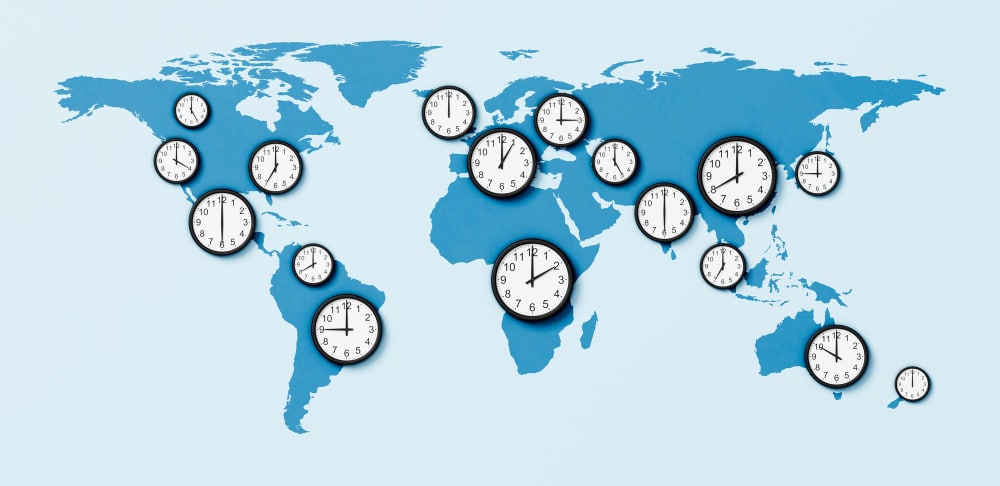
Timezone overlap. How many of your working hours does your assistant share? This drives responsiveness and how much you can hand off in real time versus asynchronously.
Cost. Rates vary enormously by region – an offshore assistant can cost a fraction of an onshore one, but price tracks more than just location (see quality and service tier below).
Data security and compliance. Your assistant handles your inbox, calendar, contracts, and private affairs. Where they are based determines which data-protection regime applies – and for European businesses, whether the arrangement is GDPR-compliant at all.
Language and cultural fit. Native or near-native English, and familiarity with how business works in your market, decide how much you have to explain and correct versus simply delegate.
No single location wins all four. The right choice is the one that fits your priorities.
Timezone, cost, data security, and quality – the four trade-offs behind where your EA should be based.
The Options Compared
Model
Typical Cost
US Timezone Fit
EU Timezone Fit
Data / GDPR
English & Culture
Offshore (Philippines)
Lowest
Poor (night shift)
Poor
Weakest
Good English, cultural gap
Latin America
Low
Good (US hours)
Poor
Variable
Good
EU-based
Mid
Workable (AM overlap)
Excellent
Strongest (GDPR-native)
Excellent
Onshore (local hire)
Highest
Excellent (US)
Excellent (EU/UK)
Strong
Native
Where to base your executive assistant, compared on the four factors that matter. Timezone fit is rated for US and European clients separately. “EU-based” is the balance most founders who value data security and quality land on.
Offshore (Philippines)
The Philippines is the default home of the low-cost virtual assistant industry, and for good reason: strong English, a large talent pool, and the lowest rates available. If price is your single most important factor and your needs are defined, task-based work, it can be excellent value.
The trade-offs are real, though. The timezone is close to opposite for both US and European clients, so your assistant is typically working your night – which pushes everything asynchronous and slows anything urgent. Cultural distance from Western business norms can mean more explaining and correcting. And data protection is the weakest of the options: for a European business handling personal data, an offshore arrangement is difficult to square with GDPR. Best for: cost-first buyers with defined, non-urgent task work.
Latin America
Latin America has become the go-to for US founders who want low cost and daytime overlap. Assistants in these timezones work broadly US hours, which solves the biggest problem with Philippines-based support for American clients, usually at a similar price point. English is generally strong.
For European businesses the picture flips – the timezone gap to Europe is as bad as the Philippines, and data-protection considerations are variable. Best for: US-based buyers who want budget rates with real-time daytime cover.
EU-Based (the balance)
An EU-based executive assistant is the option that balances all four factors rather than winning on price alone – and it is the model DonnaPro is built on.
Data and GDPR: EU-based means GDPR-native by default – the single strongest data-protection position, and effectively a requirement for many European businesses.
Timezone: excellent for European founders, and genuinely workable for US leaders – the European afternoon overlaps with the US morning, giving real-time hours at the start of the American day plus a full “your business runs while you sleep” cycle.
Quality and culture: excellent English and close familiarity with Western business norms, so you delegate outcomes rather than babysit tasks.
Cost: mid-range – more than offshore, far less than an onshore in-house hire, and all-inclusive when managed.
This is why, for founders who weigh security and quality above rock-bottom price, EU-based is usually the answer. It is also the honest counter to the offshore default: you pay more than the Philippines, but you get data protection, timezone overlap, and a quality bar that offshore task-VA providers cannot match. See how the managed model works in our comparison of an executive assistant agency versus offshore VA.
Onshore (Local Hire)
Hiring locally – an in-house or local EA in your own country – gives you native language, full timezone alignment, and the option of in-person work. If you genuinely need someone physically present or in your exact timezone at all times, it is the right call.
The cost, however, is by far the highest. A full-time in-house executive assistant runs well into six figures a year once salary, employer taxes, benefits, and overhead are counted – see our outsourced vs in-house comparison. For most founders whose work is already remote, paying onshore rates for a role that does not require physical presence is hard to justify. Best for: buyers with a genuine in-person or strict-timezone requirement and the budget to match.
How to Decide
Match the choice to your top priority:
Cost above all, defined tasks: offshore (Philippines).
US-based, want daytime cover on a budget: Latin America.
European founder, or a US founder who values data security, quality, and real overlap: EU-based.
Genuine in-person or strict same-timezone need: onshore local hire.
For most founders and CEOs – especially those handling sensitive information and wanting to delegate outcomes rather than manage tasks – the EU-based model wins the trade-off. You can see how DonnaPro matches you with an EU-based executive assistant, or read the country-specific picture for the UK and USA.
Most founders start part-time – a dedicated, AI-trained EU-based EA from €2,700 per month – and scale as they hand over more.
Where is the best place to base a virtual executive assistant?⌄
It depends on your priorities across four factors: timezone overlap, cost, data security, and quality. Offshore (Philippines) is cheapest but weak on timezone and data protection; Latin America suits US-hours cover on a budget; EU-based is the best all-round balance – GDPR-native, excellent for European founders, and workable for US leaders through morning overlap; onshore local hiring is best for in-person needs but the most expensive. For founders who value data security and quality over the lowest price, EU-based is usually the right answer.
Do I need my executive assistant in my own timezone?⌄
Not necessarily – and many founders find partial overlap is ideal. An EU-based EA gives European founders full alignment and US founders a genuine morning overlap (European afternoon is US morning) plus a full cycle where work continues while you are offline. Full same-timezone alignment mainly matters if your work requires constant real-time back-and-forth; for most delegation, a few hours of daily overlap plus asynchronous handoff is enough.
Is an offshore executive assistant GDPR-compliant?⌄
Offshore arrangements (for example, Philippines-based) are the hardest to square with GDPR, because personal data is processed outside the EU under a different regime. For European businesses handling personal data, an EU-based assistant is the strongest and simplest position – GDPR applies natively. If you use an offshore provider, confirm their exact data-handling, transfer safeguards, and compliance terms directly before engaging.
Why choose an EU-based EA over a cheaper offshore one?⌄
You pay more than offshore, but you get three things offshore task-VA providers struggle to match: GDPR-native data protection, real timezone overlap with both Europe and the US, and a higher quality and cultural-fit bar that lets you delegate outcomes rather than manage tasks. For founders handling sensitive information or wanting a genuine operational partner, that balance is worth the difference. Cost-first buyers with simple, defined tasks may still prefer offshore.
Filip Pesek spent more than seven years building delegation systems the hard way: through trial, error, and eventually a complete rethink of how founders should work with assistants. Before DonnaPro, he founded Spark, a marketing agency, and wrote the bestselling book Pisma za Leona. DonnaPro grew directly from the systems Filip developed for himself, and later shared with the founders and CEOs who kept asking how he managed to work the way he did. He writes about delegation, founder leverage, and building businesses that do not depend on the person at the top holding everything together.
Related Guides & Resources
Explore more guides to help you hire, work with, and get the most from your executive assistant.
Ecommerce founders drown in operations instead of growing the business. An ecommerce executive assistant owns the operational layer. What to delegate, and what it costs.