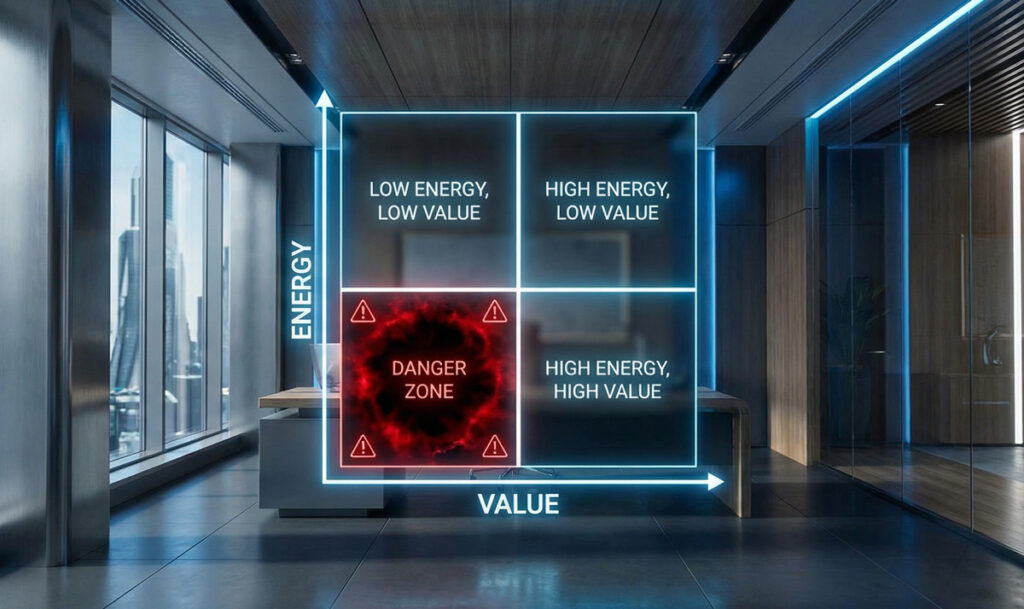
The CEO's Transfer Blueprint: How to Turn "Danger Zone" Tasks into Scalable Playbooks
-
 Written by:
Filip Pesek
Written by:
Filip Pesek - Published:


You’ve done the hard work. You’ve completed your 7-Day Buyback Audit and have a clear, perhaps frightening, list of tasks in your “Danger Zone”-high-energy, low-value work that is sucking up your time.
Now you face the most common hurdle in the Buyback Loop: the Transfer phase.
This is where most CEOs stall. The thought of stopping to teach someone else how to do a task you can do in your sleep feels inefficient. You think, “It’s faster if I just do it myself,” or “Nobody else will do it to my standard.“
This mindset is the primary bottleneck in your business.
To break through, you don’t need more time; you need a system to extract knowledge from your head and turn it into a repeatable process. You need to build Playbooks.
A Playbook is the bridge between identifying a task and successfully delegating it to a Virtual Executive Assistant. It turns tribal knowledge into a scalable company asset.
Here is your 4-step blueprint to moving tasks from your “Danger Zone” into a Playbook.
Table of Contents
The "Bus Factor" and Why It’s Holding You Back
Ask yourself: If you got hit by a bus tomorrow, could your business continue to operate without chaos?
If the answer is no, you have a “Bus Factor” of one. Vital knowledge is trapped in your head. Every time you personally handle a repeatable task-like client onboarding, monthly reporting, or managing listing checklists for a real estate virtual assistant-you are perpetuating this risk.
Creating a Playbook isn’t just about saving time; it’s about de-risking your business and building an asset that holds value independent of your personal involvement.
Your Transfer Toolkit: The 4 C’s Framework
Dan Martell’s 4 C’s Framework is the fastest way to create a Playbook without having to sit down and write a 50-page manual. It’s designed for speed and clarity.
For a deeper dive into this concept, read Golden Concept 5 in our guide on Dan Martell’s “Buy Back Your Time” Playbook.
1. Camcorder (Record It)
The next time you have to perform a “Danger Zone” task, don’t just do it-record it. Use a tool like Loom to capture your screen and your voice. As you work, talk through what you are doing and why. This captures the nuance that a written document often misses. This recording is the raw material for your Playbook.
2. Course (Document It)
You don’t need to do this step. Send the recording to your current assistant, a temporary VA, or even use an AI transcription tool. Their job is to watch the video and turn your actions into a step-by-step written procedure. This document becomes the “Course” on how to perform that specific task.
3. Cadence (Schedule It)
Define the rhythm of the task. Does it happen daily by 9 AM? Weekly on Fridays? Monthly on the 1st? Clear expectations about timing are just as important as the steps themselves.
4. Checklist (Quality Control It)
Extract the critical success factors from the “Course” into a simple, pass/fail checklist. Before your VA says a task is “done,” they must run it against this checklist. This is your quality assurance mechanism and the key to trusting that the work meets your standards.
What About "Creative" or "Unique" Tasks?
Some tasks in your Danger Zone might feel too subjective for a simple checklist. For projects requiring your unique vision-like drafting a keynote speech or designing a new strategic initiative-use the 10/80/10 Rule.
- 10% (Ideation): You provide the initial vision, outline, and constraints.
- 80% (Execution): Your Executive Assistant does the heavy lifting of research, drafting, and assembly.
- 10% (Integration): You step back in for the final polish and approval.
This approach allows you to maintain creative control while offloading the time-consuming execution.
Learn more about applying Golden Concept 6: The 10/80/10 Rule in the full “Buy Back Your Time” overview.
Conclusion: From Playbook to Freedom
A Playbook sitting on a digital shelf is useless. Its power is unlocked only when you hand it to someone capable of executing it reliably.
The Transfer phase isn’t complete until the task is off your plate for good.
You have your Audit results. You now have the blueprint to create Playbooks. The final step is to partner with a professional who can take these Playbooks and run with them.
Don’t let your newfound clarity go to waste. Take the final step and hire a C-level Virtual Executive Assistant ready to execute your Playbooks from day one.
Experience the difference of true delegation with DonnaPro.
FAQ: Your Task Transfer Questions Answered
I don't have time to record videos. Is there a faster way?
Recording yourself doing a task you already have to do takes almost zero extra time. The alternative-continuing to do the task yourself forever, or fixing mistakes from poorly delegated work-takes exponentially more time. The 4 C’s method is designed to be the path of least resistance.
What if my assistant doesn't understand the Playbook?
This is actually a good thing. It exposes a gap in the process, not necessarily the person. Have them ask clarifying questions and then update the Playbook immediately with the new information. A Playbook is a living document that gets stronger with every iteration.
Can I use the 4 C's for complex, multi-person workflows?
Yes, but break it down. A complex workflow is just a series of smaller, linked tasks. Create a separate Playbook for each sub-task and then a “master” Playbook that outlines how they all connect.
I've created Playbooks, but I still don't trust anyone to execute them. What now?
Trust is built through verification. Use the Checklist from the 4 C’s. Start by having your VA execute the task and send it to you for review before it goes live. Once they consistently hit the checklist standards, you can move to spot-checking, and eventually, full autonomy. This graduated approach builds confidence for both of you.