The CEO’s Delegation Playbook: Frameworks for Scaling Your Leadership
Advanced delegation frameworks for CEOs and founders. Learn what to delegate, how to delegate effectively, and avoid common mistakes that limit your growth.
Strategic delegation is the intentional transfer of tasks, decisions, and responsibilities to free leadership capacity for high-value work. It’s not about offloading your to-do list – it’s about systematically removing yourself as the bottleneck so your business can scale beyond your personal bandwidth. This playbook covers the frameworks, the audit, the handoff process, and the system.
You didn’t become a founder to manage inboxes. You didn’t build a company to coordinate travel schedules or format presentations.
Strategic delegation is the intentional transfer of tasks, decisions, and responsibilities to free leadership capacity for high-value work. It’s not about offloading your to-do list – it’s about systematically removing yourself as the bottleneck so your business can scale beyond your personal bandwidth.
Part 1: Why CEO Delegation Fails (And How to Fix It)
Before any framework can be effective, the right mindset is essential. Many leaders struggle with delegation not because of a lack of talent on their team, but because of their own psychological barriers.
Barrier #1: “It’s Faster If I Just Do It Myself”
This is the most common trap. The irony: the reason you don’t have time to delegate is because you’re not delegating. Every minute spent on a delegable task is a minute stolen from high-leverage work.
Barrier #2: Perfectionism Paralysis
This is the perfectionist’s dilemma – and it’s a direct obstacle to scale. Redoing work that was “good enough” destroys your delegate’s confidence and wastes everyone’s time.
Barrier #3: No Feedback Loop
Delegation without feedback leads to repeated mistakes and stagnant performance. Delegating something one week, then doing it yourself the next, creates confusion about responsibilities.
What Cannot Be Delegated
Not everything should be handed off. Your primary responsibility as CEO is to lead – to set vision, build key relationships, and make high-level strategic decisions. These are the things that cannot be delegated:
Final strategic decisions
Key investor and board relationships
Senior hiring decisions
Company culture and values
Crisis leadership
Every minute spent on a delegable task is a minute stolen from these critical functions.
Part 2: What to Delegate – Strategic Frameworks
Effective CEO delegation isn’t about randomly offloading your to-do list. It’s a strategic process of filtering which tasks to keep and which to hand off.
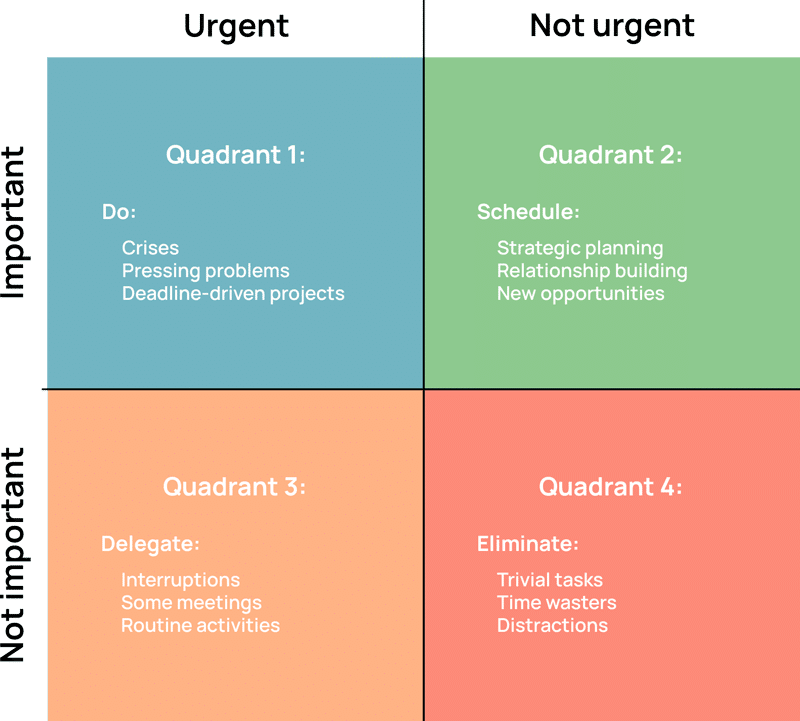
The Eisenhower Matrix categorises tasks into four quadrants: most CEOs spend too much time in Quadrants 1 and 3, and too little in Quadrant 2 where strategic value is created.
Framework 1: The Eisenhower Matrix
This classic tool categorises every task into four quadrants based on urgency and importance:
Quadrant 1 – Urgent & Important (Do Now): Crises, deadlines, critical problems
Quadrant 2 – Important but Not Urgent (Schedule): Strategic planning, relationship building, deep work
Quadrant 3 – Urgent but Not Important (Delegate): Most meetings, routine emails, interruptions
Quadrant 4 – Neither Urgent nor Important (Eliminate): Time wasters, trivial tasks
The key insight: most CEOs spend too much time in Quadrants 1 and 3, and too little in Quadrant 2. Strategic delegation shifts this balance.
Framework 2: The Value-Time Filter
A more granular approach analyses tasks based on their monetary value:
€100/Hour Tasks – Complex operational work: Managing calendar, preparing expense reports, coordinating travel logistics, following up on outstanding items
€1,000+/Hour Tasks – Activities only you can do: Investor relationships, strategic decisions, senior hiring, partnership negotiations
By systematically delegating €10 and €100 tasks, you free capacity to focus exclusively on €1,000+ work that drives real growth.
Framework 3: The Energy Audit
Beyond time and value, consider energy. Some tasks drain you disproportionately – even if they don’t take much time, they consume mental bandwidth and leave you depleted for high-value work.
Which tasks do I consistently procrastinate on?
Which tasks leave me frustrated or exhausted?
Which tasks distract me even when I’m not doing them?
These energy-draining tasks are high-priority delegation candidates, regardless of their position in other frameworks.
Part 3: The 15-Minute Delegation Audit
Theory is useful, but action drives results. Here’s a simple exercise you can complete in 15 minutes. The goal isn’t to create more work – it’s to create a clear starting point.
The 15-minute delegation audit gives you three concrete lists: recurring tasks to delegate immediately, energy-draining tasks to hand off, and strategic projects to start once bandwidth opens.
The Recurring Tasks Audit (5 Minutes)
List 5-10 tasks you find yourself doing every week:
List 1-3 strategic projects you’d start with an extra 10 hours per week:
Deep-dive competitor analysis
Mapping out new market entry
Nurturing relationships with potential investors
Building a content strategy
This simple list is now a powerful roadmap. A skilled EA can immediately take over recurring tasks, systematise the work you dislike, and begin foundational research for your strategic projects. Whether it’s a shared spreadsheet, Notion database, or project management tool – the format matters less than the discipline of keeping it updated.
Part 4: How to Delegate – The 5-Step Process
Knowing what to delegate is half the equation. How you hand off work determines whether delegation succeeds or fails.
Step 1: Define the Desired Outcome
Start with the end in mind. Communicate clearly:
Clear description of the end result
Context on why this matters
Deadline and any interim milestones
How success will be measured
Step 2: Provide Resources and Authority
Set your delegate up for success. This means granting:
Access to necessary tools and information
Budget authority if relevant
Decision-making power within defined boundaries
Introduction to relevant stakeholders
Nothing is more frustrating than being given responsibility without the power to act.
Step 3: Establish Communication Checkpoints
Avoid the extremes of micromanaging or disappearing entirely. Establish clear checkpoints:
When should they update you on progress?
What decisions can they make independently?
What requires your input before proceeding?
How should they flag problems?
For routine tasks, a weekly summary may suffice. For complex projects, brief daily check-ins during critical phases.
Step 4: Create Accountability
Accountability should be constructive, not punitive. Establish:
Clear ownership (one person responsible, not “the team”)
Metrics for success
Regular review of outcomes
Recognition for good work
According to DonnaPro, the most successful delegation relationships include explicit “what does success look like” conversations before work begins, not after.
Step 5: Close the Loop
After completion, reflect:
What went well?
What could be improved?
Should this become a recurring delegation?
Does the process need documentation?
Each delegation cycle should improve the next one. Over time, you’ll build a library of documented processes and a team that operates with increasing autonomy.
Part 5: Common Delegation Mistakes
Even experienced leaders fall into these traps:
The six most common CEO delegation mistakes – from delegating without context to perfectionism paralysis – and how each creates the bottleneck it was meant to solve.
Mistake 1: Delegating Without Context
Handing off tasks without explaining why they matter leads to poor prioritisation and decisions that miss the mark.
Mistake 2: Reverse Delegation
This happens when you delegate a task, then take it back when problems arise. It teaches your team that if they struggle, you’ll rescue them.
Mistake 3: Delegating Only Tasks, Not Decisions
If every decision still flows through you, you haven’t really delegated – you’ve just added a middleman.
Mistake 4: Perfectionism Paralysis
Redoing work that was “good enough” destroys your delegate’s confidence and wastes everyone’s time.
Mistake 5: No Feedback Loop
Delegation without feedback leads to repeated mistakes and stagnant performance.
Mistake 6: Inconsistent Delegation
Delegating something one week, then doing it yourself the next, creates confusion about responsibilities.
Part 6: Building Your Delegation System
Individual delegation is good. A delegation system is transformative.
The delegation ladder: moving tasks from Level 1 (do as told) through Level 5 (full autonomy) is the goal of a mature delegation system – and what separates CEOs who scale from those who bottleneck.
Create a Delegation Playbook
Create a simple playbook documenting:
Tasks you’ve delegated
Who owns each task
Standard processes and preferences
Decision-making boundaries
Communication expectations
This playbook becomes invaluable – for consistency, for onboarding new team members, and for continuous improvement.
The Weekly Delegation Review
Spend 15 minutes weekly reviewing:
What did I do this week that should have been delegated?
What’s still on my plate that someone else could own?
What delegation is working well?
What needs adjustment?
This regular reflection prevents delegation drift – the tendency to gradually reclaim tasks over time.
The Delegation Ladder
Not all delegation is equal. Progress through these levels:
Level 1: Do as told – wait for instructions
Level 2: Research and report – investigate and return options
Level 3: Recommend and wait for approval
Level 4: Act and report – decide and inform afterwards
Level 5: Full autonomy – decide and act without reporting
The goal is moving tasks up the ladder over time, building toward true autonomy. Strategic delegation is the key to unlocking your next level of growth. It’s the conscious decision to let go of the good to make room for the great.
How do I know when it's the right time to get an Executive Assistant?⌄
If you’re spending more than 10 hours weekly on administrative tasks, or if your to-do list consistently prevents you from strategic work, it’s time. Other signals: missed opportunities due to bandwidth constraints, consistently working evenings and weekends on admin, and feeling like you’re the bottleneck for basic operational tasks.
What's the difference between delegation and just offloading tasks?⌄
Offloading is reactive – getting rid of what’s overwhelming you. Delegation is strategic – intentionally transferring work to free capacity for higher-value activities. Effective delegation includes context, clear outcomes, appropriate authority, checkpoints, and feedback. Offloading often lacks all of these.
My business is highly specialised. How can an external EA understand our needs?⌄
Skilled EAs are professional learners. At a virtual assistant agency like DonnaPro, assistants have supported leaders across 110+ industries. They don’t need to be sector experts – they need to understand your priorities, stakeholders, and communication style. Most of what an EA handles is universal: inbox management, calendar, travel, follow-up, research. The context they need comes from onboarding, not a degree.
What if I delegate a task and it doesn't meet my standards?⌄
First, assess whether the gap is significant or just stylistic preference. For genuine issues, provide specific feedback and clarify expectations. One imperfect result isn’t failure – it’s calibration. Quality comes from clarity: define what “good” looks like, provide examples, and create space for questions before the work starts.
Can I trust an external assistant with confidential information?⌄
Yes, with appropriate safeguards. Professional EAs from managed agencies like DonnaPro are bound by NDAs, operate under enterprise-grade security protocols, and are vetted for discretion. Start with less sensitive work, build trust through demonstrated reliability, then expand access as the relationship matures.
What tasks should I delegate first?⌄
Start with high-frequency, clearly-defined tasks: calendar management , email triage , travel coordination , expense processing, and scheduling. These create immediate time savings, are easy to hand off, and give your EA the context to take on more complex work over time.
How do I maintain quality when delegating?⌄
Clear expectations upfront, regular check-ins during execution, and feedback after completion. Quality comes from clarity, not control. Define what “good” looks like, provide examples, and create space for questions before the work starts rather than corrections after.
What if my team resists taking on delegated work?⌄
Resistance usually stems from unclear expectations, insufficient resources, or fear of failure. Address the root cause: clarify the “why,” ensure they have what they need, and create psychological safety to ask questions and make mistakes. Recognition for successful delegation also builds momentum.
How much time should I invest in delegation?⌄
Expect to invest 30-60 minutes upfront for each new task you delegate (explanation, documentation, initial oversight). This pays back quickly – a task that takes you 2 hours weekly costs 8 hours monthly. Invest once, recover that time every month thereafter.
How is working with an agency EA different from hiring directly?⌄
Agency EAs come pre-trained with established systems and playbooks. You skip recruitment and onboarding overhead – the agency handles vetting, matching, and continuity. You also get backup support if your EA is sick or on holiday, and a quality management layer monitoring the engagement without adding it to your calendar.
Filip Pesek spent more than seven years building delegation systems the hard way: through trial, error, and eventually a complete rethink of how founders should work with assistants. Before DonnaPro, he founded Spark, a marketing agency, and wrote the bestselling book Pisma za Leona. DonnaPro grew directly from the systems Filip developed for himself, and later shared with the founders and CEOs who kept asking how he managed to work the way he did. He writes about delegation, founder leverage, and building businesses that do not depend on the person at the top holding everything together.
Related Guides & Resources
Explore more guides to help you hire, work with, and get the most from your executive assistant.
Ecommerce founders drown in operations instead of growing the business. An ecommerce executive assistant owns the operational layer. What to delegate, and what it costs.