65% of Executive Support Roles Can Be Done Remotely: Why Your Next Assistant Does Not Need a Desk
Research puts 65% of executive support roles as fully remote-capable. What has moved online, what still needs presence, and what a virtual EA costs against an in-house hire.
Written byFilip PesekFounder and Chief Executive Officer
PublishedSep 17, 2026
Research by Dingel and Neiman found that 65% of office and administrative support roles can be performed entirely from home (Journal of Public Economics, 2020). McKinsey’s analysis confirmed that management and business service roles spend more than half their time on remotely deliverable tasks. For a CEO choosing between an in-office PA and a virtual executive assistant at €2,700 per month, the question is no longer whether remote support can work. It is why you would pay for a desk when the work no longer requires one.
Introduction
Ten years ago, an executive assistant sat outside the office door. The diary was a desk diary, the post was physical, and half the job involved being in the building: greeting visitors, sorting the in-tray, handing a printed brief to the CEO between meetings.
Well, not anymore. The diary is Google Calendar or Outlook. The post is email. The brief is a shared Google Doc. The visitors book themselves in through a calendar app. A McKinsey analysis of over 2,000 work activities across 800 jobs found that roles in management and business services now spend more than half their time on activities that can be delivered remotely (McKinsey Global Institute, “What’s Next for Remote Work,” 2020 (opens in a new tab)). For executive support specifically, Dingel and Neiman’s peer-reviewed research puts the figure at 65% of roles fully performable from home (Journal of Public Economics, 2020 (opens in a new tab)).
That shift did not happen overnight, and it was not caused by the pandemic alone. The pandemic accelerated it, but the underlying change is structural: the tools that CEOs and their teams use every day are cloud-based, and anyone with the right access and the right judgement can operate them from anywhere.
This guide looks at what that means in practice for CEOs and founders considering executive support. It walks through which tasks have genuinely moved online, where physical presence still matters, and why the evidence increasingly points toward virtual executive assistants as the logical default for most leaders under 50 employees.
What has actually moved online
The easiest way to see the shift is to list the core tasks of an executive assistant and ask which ones still require someone in the same building.
Fully digital, no physical presence needed:
Inbox management. Sorting, triaging, drafting replies, flagging priorities. Email has been digital since the beginning; the difference is that shared inbox tools now make it possible for someone in another country to manage a CEO’s email as effectively as someone at the next desk.
Calendar and scheduling. Booking, rescheduling, protecting focus time, coordinating across time zones. Calendar platforms are cloud-native. There is no in-person advantage here.
Travel booking. Flights, hotels, ground transport, visa logistics, itinerary building. Online booking platforms and travel management tools have made this entirely location-independent.
Meeting preparation. Agenda drafts, briefing notes, attendee research, document assembly. All of this happens in shared documents and presentation tools.
Follow-ups and action tracking. Chasing outstanding tasks, tracking deadlines, nudging stakeholders. Project management and task tools handle this without anyone needing to walk to someone’s desk.
Expense and receipt management. Digital receipt capture, categorisation, submission through expense platforms. Physical receipts are the exception, not the rule.
Document preparation. Slide decks, reports, proposals, formatting. Every major business document tool is cloud-based.
Stakeholder communication. Drafting messages, coordinating introductions, maintaining relationship notes. CRM systems and email handle all of it remotely.
Still partially physical (but shrinking):
Event logistics. On-site coordination on the day still requires presence, but the planning, vendor management, invitations and follow-up are all digital.
Office management. Ordering supplies, liaising with building management, coordinating with IT on physical equipment. These tasks exist only if the company has a physical office, and even then they are increasingly handled through online ordering and ticketing systems.
Personal errands. Dry cleaning, gift purchasing, restaurant bookings. Some of these require local knowledge or physical collection, though most can be managed through delivery services and online booking.
The pattern is clear. The tasks that define executive support are overwhelmingly digital. Microsoft’s Work Trend Index, based on aggregated data from millions of Microsoft 365 users, found that across Microsoft 365 apps, employees split their time between communication at 57% (email, chat and meetings) and creation at 43% (documents, spreadsheets and presentations) (Microsoft, “Will AI Fix Work,” 2023 (opens in a new tab)). Both categories are tasks an executive assistant performs daily, and neither requires the assistant to be in the same building. The executive assistant’s workspace is no longer a desk outside the CEO’s office. It is a screen, a set of permissions, and a secure WiFi connection.
The productivity question
The concern most CEOs raise about virtual support is productivity: will someone working remotely be as effective as someone I can see? The evidence is now substantial enough to answer that directly.
A Stanford University study found that remote work increased individual productivity by 13%, driven primarily by fewer interruptions and a quieter working environment (Nicholas Bloom, Stanford, 2015 (opens in a new tab)). In 2022, Great Place To Work’s two-year study of more than 800,000 employees found stable or improved productivity after transitioning to remote work (Great Place to Work, 2022 (opens in a new tab)).
The productivity question, in other words, has been answered. Remote executive support works at least as well as in-office support for the tasks that make up the vast majority of the role, and the cost structure is significantly more favourable.
Why “remote” is not the same as “less capable”
The assumption behind the desk-outside-the-door model is that proximity creates capability. The assistant overhears a conversation and acts on it. The CEO leans out and asks for something. The physical closeness reduces friction.
That assumption made sense when information lived in filing cabinets and conversations happened exclusively in corridors.
It makes far less sense when the CEO’s calendar, email, task list and documents are all accessible through the same cloud platforms regardless of where the assistant sits.
What actually determines an EA’s effectiveness is not location.
It is three things:
access (to the systems and information they need)
context (understanding the CEO’s priorities, preferences and working patterns)
judgement (knowing when to act, when to escalate, and when to stay out of the way)
None of these requires physical proximity. All of them require seniority, training and a structured onboarding process.
This is the difference between a virtual assistant and a virtual executive assistant. A VA follows instructions. An EA exercises judgement. The question is not whether that judgement can operate remotely. It is whether the EA has the calibre and the systems to deliver it, which is what our guide on how a VA compares to an EA sets out in detail.
McKinsey’s survey of 300 global C-suite executives found that leaders expect 50 to 70% of their general and administrative employees to work remotely for a substantial portion of their time going forward, with only 20% expecting a full return to office (McKinsey, “Getting Remote Work Right for G&A Functions,” 2021 (opens in a new tab)).
The direction of travel is settled. The question for individual CEOs is whether to move with it now or wait until the in-office model becomes harder to justify.
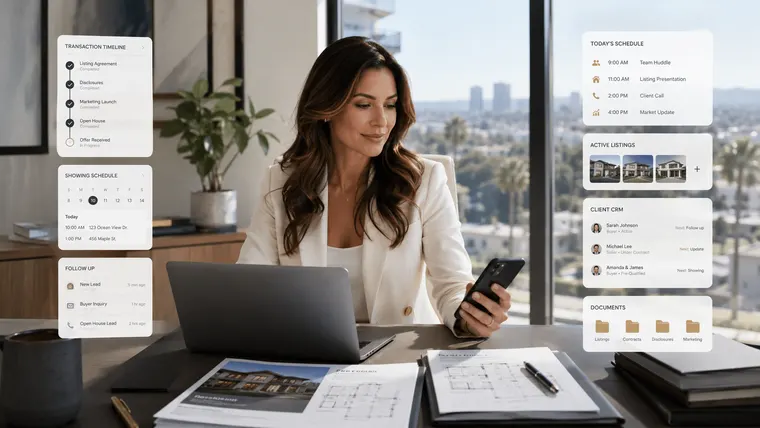
The workspace that replaced the desk outside the office door.
The cost advantage of removing the desk
The financial case for virtual executive support is straightforward once you compare like for like.
An in-house executive assistant in the UK costs £28,000 to £75,000 per year in salary, depending on seniority and location (Robert Walters, 2026 UK Salary Survey (opens in a new tab)). Add employer National Insurance, pension contributions, office space, equipment, recruitment fees and management time, and the true annual cost is closer to £38,000 to £100,000. That also assumes you need a full-time hire, which most CEOs at the 5-to-30-person stage do not, as our guide on when to hire an executive assistant explains.
A managed virtual EA through an agency costs €2,700 / £2,350 per month, with none of the employer overhead. The EA works part-time, typically 15 to 25 hours per week, which is what the admin load actually requires at this stage. The agency handles vetting, training, cover during holidays, and performance management, so the CEO is not spending their own time recruiting or supervising. You can see the full breakdown on our pricing page.
The desk itself is not free either. Office space in the UK averages £4,000 to £12,000 per year per workstation depending on the city, before utilities, IT infrastructure and building services. Removing one workstation does not save that full amount, but it is a cost that virtual support avoids entirely.
The calculation is not simply about saving money. It is about paying for capability rather than presence. A virtual EA model means the CEO gets senior-level executive support without committing to a full-time salary, a desk, and the management overhead of an employee, and the EA’s working hours go directly to productive work rather than being diluted by the overhead of being in an office. Our full cost comparison sets the two models side by side.
What to look for in a virtual EA provider
Not every virtual assistant is equipped to handle executive-level work remotely. The gap between a £10-per-hour task assistant and a managed executive assistant is the gap between someone who follows a checklist and someone who owns a process. Here is what separates the two.
Vetting and seniority. A credible provider recruits experienced professionals, not entry-level generalists. The EA should have prior experience supporting senior leaders, managing complex calendars, and making judgement calls about priorities.
Managed service, not marketplace. Marketplace platforms connect you with a freelancer and leave you to manage the relationship. A managed agency handles onboarding, quality, backup cover and escalation. The difference matters most when something goes wrong or when you need consistency during holidays and absences.
Security and confidentiality. Executive support involves access to sensitive information: inboxes, financial documents, board papers, personal data. The provider should have clear data handling policies, secure access protocols, and confidentiality agreements that meet the standards a CEO would expect of an in-house hire. This is part of what our executive assistant services include as standard.
Structured onboarding. The first month with any new EA is a learning period. A good provider builds this into the service: a defined onboarding process, daily check-ins during the first two weeks, and a calibration period where the EA learns the CEO’s working patterns. This is what turns remote support from a cost saving into an operational advantage.
European time zone coverage. For CEOs operating across Europe and the UK, an EA who works within one or two time zones of the client is a practical necessity. Real-time responsiveness matters for calendar management and inbox triage, and a significant time zone gap undermines the responsiveness that makes the relationship work. Our guide on how to choose an EA agency covers what to check before you commit.
If the work is already digital, the only question left is who does it. Book a free strategy session and we will map which of these tasks can move off your plate, what a dedicated EA working your hours would own, and what it costs against the desk you would otherwise be paying for.
Most of my executive tasks are digital now. Does that mean I can use a virtual EA instead of hiring someone in-house?⌄
Yes. If the work is email, calendar, travel, meeting prep, follow-ups and document management, all of it runs through cloud-based tools that a virtual EA can access from anywhere. Dingel and Neiman's research found that 65% of office and administrative support roles are fully remote-capable. Most CEOs at the 5-to-30-person stage find that a managed virtual EA at €2,700 / £2,350 per month covers the same scope as an in-house hire at £38,000 to £100,000 per year, without the employer overhead.
Is a virtual executive assistant as productive as an in-house one?⌄
The evidence says yes. Stanford research found a 13% productivity increase for remote workers. The marginal task difference is offset by higher availability, lower cost, and the elimination of office-related overhead.
What executive support tasks still need someone physically present?⌄
Very few. On-the-day event coordination, physical mail handling, and some personal errands still benefit from local presence, but these are a small fraction of the typical EA workload. The core functions that consume the most time, including inbox management, calendar ownership, travel logistics, meeting preparation and stakeholder communication, are entirely digital and location-independent.
How do I keep my information secure with a remote EA?⌄
The same way you secure any remote access: role-based permissions, two-factor authentication, secure shared workspaces, and a clear confidentiality agreement. A managed EA agency handles this as part of the service, including data handling policies and secure onboarding protocols. The security risk is no different from giving a new in-house hire access to your systems, and in practice it is often better managed because the agency has a standardised process.
Will a virtual EA understand my business well enough to make judgement calls?⌄
This depends on the calibre of the EA and the quality of the onboarding, not on location. A senior EA with experience supporting founders will learn your priorities, communication style and decision patterns within the first month, whether they sit across the hall or across the continent. The key is structured onboarding: daily check-ins for the first two weeks, clear outcome definitions, and a feedback rhythm that accelerates the learning curve.
I have tried working with a remote VA before and it did not work. Why would a virtual EA be different?⌄
A VA follows instructions on defined tasks. An EA exercises judgement, owns processes, and anticipates needs, as our VA vs EA comparison sets out. If a previous remote arrangement failed because the person needed constant direction or lacked context, the issue was capability, not location. A managed EA through a professional agency is vetted for executive-level work and supported by structured onboarding and quality management.
Filip Pesek spent more than seven years building delegation systems the hard way: through trial, error, and eventually a complete rethink of how founders should work with assistants. Before DonnaPro, he founded Spark, a marketing agency, and wrote the bestselling book Pisma za Leona. DonnaPro grew directly from the systems Filip developed for himself, and later shared with the founders and CEOs who kept asking how he managed to work the way he did. He writes about delegation, founder leverage, and building businesses that do not depend on the person at the top holding everything together.
Related Guides & Resources
Explore more guides to help you hire, work with, and get the most from your executive assistant.
Ecommerce founders drown in operations instead of growing the business. An ecommerce executive assistant owns the operational layer. What to delegate, and what it costs.
This guide draws on peer-reviewed academic research (Dingel and Neiman, 2020), McKinsey Global Institute analysis of remote work potential across 2,000 activities and 800 jobs, Microsoft's Work Trend Index aggregating data from millions of Microsoft 365 users, and a Stanford University study on remote work productivity. UK salary data is from Robert Walters' 2026 survey. The McKinsey C-suite survey on remote G&A functions included 300 global executives.
All costs are indicative and will vary by provider, location, and scope of service. Readers should verify current pricing directly with providers.
Citations
Jonathan Dingel and Brent Neiman, "How Many Jobs Can Be Done at Home?" Journal of Public Economics, 2020 - remote work potential by occupation. sciencedirect.com/science/article/abs/pii/S0047272720300992
McKinsey Global Institute, "What's Next for Remote Work: An Analysis of 2,000 Tasks, 800 Jobs, and Nine Countries," 2020 - task-level remote work analysis. mckinsey.com/featured-insights/future-of-work/whats-next-for-remote-work-an-analysis-of-2000-tasks-800-jobs-and-nine-countries
Microsoft, "Will AI Fix Work?" Work Trend Index, 2023 - knowledge worker time allocation in digital tools. microsoft.com/en-us/worklab/work-trend-index/will-ai-fix-work
McKinsey, "Getting Remote Work Right for G&A Functions," 2021 - C-suite expectations for remote G&A. mckinsey.com/capabilities/operations/our-insights/virtually-possible-getting-remote-work-right-for-g-and-a-functions
Nicholas Bloom, Stanford University, remote work productivity study - 13% productivity increase. nbloom.people.stanford.edu/research
Great Place to Work, "Remote Work Productivity Study," 2022 - 800,000 employee analysis. greatplacetowork.com/resources/blog/remote-work-productivity-study-finds-surprising-reality-2-year-study
Robert Walters, 2026 UK Executive Assistant Salary Survey - in-house EA salary ranges. robertwalters.co.uk/our-services/salary-survey/executive-assistant-salaries.html