The CEO's Growth Engine: How to "Fill" Your Reclaimed Time with High-Impact Strategy
-
 Written by:
Filip Pesek
Written by:
Filip Pesek - Published:


Congratulations. You’ve successfully navigated the hardest parts of the Buyback Loop.
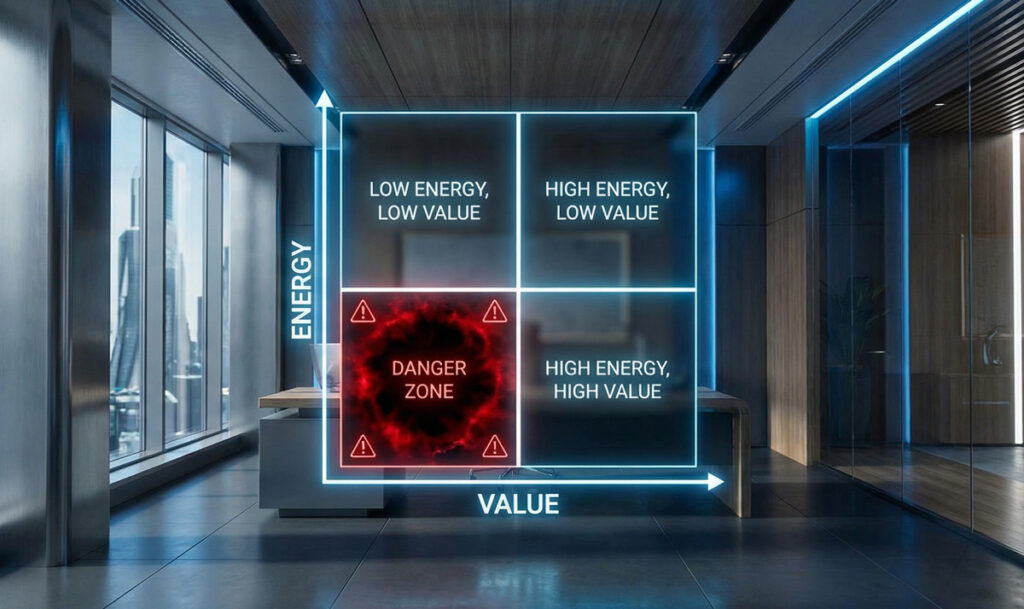
You completed the 7-Day Buyback Audit and honestly identified the “Danger Zone” tasks draining your energy. You followed the Transfer Blueprint to create scalable Playbooks and delegate those tasks to your Executive Assistant.
For the first time in months, perhaps years, you look at your calendar and see white space.
Now you face the final, critical challenge of the Buyback Principle: the Fill phase.
This is where many CEOs stumble. Nature abhors a vacuum, and so does your calendar.
If you do not intentionally fill that reclaimed white space with high-value activities, it will automatically fill itself with low-value noise – scrolling LinkedIn, sitting in meetings you don’t need to attend, or worse, micromanaging the very tasks you just delegated.
The goal of the Buyback Loop isn’t just to empty your calendar; it’s to refill it with the work only you can do. It’s about shifting from low-leverage execution to high-leverage strategy.
Here is your guide to ensuring your reclaimed time becomes your business’s greatest growth engine.
Table of Contents
The Trap: The Addiction to "Busyness"
As a founder or CEO, you are likely addicted to the dopamine hit of solving immediate problems. It feels productive to answer 50 emails or put out a client fire.
Strategic thinking, relationship building, and visionary planning do not offer immediate gratification. They are harder, slower, and require deep mental energy.
When faced with open time, your instinct will be to slide back into the comfort zone of “busyness.” You must resist this. The Fill phase requires discipline to protect your new time for activities that yield a 10x return, not just a 1x return.
Defining Your "10x" Activities
What should you actually do with those extra 10 to 20 hours a week? You need to focus on activities that move the needle exponentially.
Based on Dan Martell’s concepts, your time should be reinvested into three primary buckets related to your 10x Vision Map:
1. Strategic Deep Work (The Vision)
This is time spent entirely offline, thinking about the future of the company. This isn’t answering emails about next week; it’s planning next year.
- Examples: Developing a new product roadmap, analyzing potential acquisitions, refining the company’s 3-year vision, or crafting the messaging for a major pivot.
2. High-Leverage Relationships (The Network)
Business is fundamentally about people. Now that you aren’t buried in admin, you have time to nurture the relationships that matter most.
- Examples: Meetings with key investors, recruiting top-tier C-level talent, wooing your biggest potential clients, or attending high-level industry masterminds.
3. Personal Regeneration (The Fuel)
You cannot lead a 10x company if you are running on fumes. The Buyback Principle is also about buying back your life.
- Examples: Leaving the office at 5 PM to be present with your family, prioritizing your health, or engaging in hobbies that recharge your creative batteries.
How to Operationalize the "Fill" Phase
You cannot just hope you’ll spend time on strategy. You must schedule it with the same rigidity as a board meeting.
1. Implement "Deep Work" Blocks
Author Cal Newport defines Deep Work as professional activities performed in a state of distraction-free concentration that push your cognitive capabilities to their limit.
Schedule at least three 90-minute “Deep Work” blocks on your calendar every week. During this time, Slack is off, email is closed, and your phone is in another room. This is when the real strategy happens.
2. Utilize Theme Days
To avoid cognitive switching costs, batch your high-value activities into specific days.
Mondays: Internal team leadership and weekly syncs.
- Tuesdays & Wednesdays: Deep strategy and product focus.
- Thursdays: External relationships, sales, and podcasts.
- Fridays: Company culture, review, and planning next week.
3. The "Assistant Firewall"
Your Virtual Executive Assistant is the guardian of your new schedule. They must be empowered to protect your “Fill” time aggressively. If someone tries to book over your strategy block, your EA’s job is to say “No.”
Conclusion: The Ultimate Freedom
The journey through Audit, Transfer, and Fill is transformational.
You go from a reactive operator drowning in noise to a proactive leader designing the future. You move from a business that relies on your brute-force effort to one that scales through systems and leverage.
The white space on your calendar isn’t emptiness; it’s opportunity.
If you know what you would fill that time with, but are still stuck in the “Danger Zone” of administrative chaos, it’s time to close the loop.
Hire a dedicated Virtual Executive Assistant through DonnaPro today, and start filling your days with the work that truly matters.
FAQ: Mastering Your Reclaimed Time
I feel guilty when I'm not constantly "busy." How do I handle this?
This is normal “founder guilt.” Recognize that your value has shifted. Your value is no longer measured by how many tasks you complete, but by the quality of the decisions you make. A rested, strategic CEO is infinitely more valuable than a busy, burnt-out one.
What if I use my "Deep Work" time and come up with nothing?
Strategy is messy. Some sessions will feel unproductive. That’s part of the process. The commitment to the practice of deep thinking is what yields results over time. Don’t give up on it just because one session felt slow.
My team keeps interrupting my strategy blocks. What do I do?
You have a culture issue, not a time issue. You need to set clearer boundaries and empower your Executive Assistant to enforce them. If your team cannot function for 90 minutes without you, you need to revisit the Transfer phase and build better Playbooks for them.
Can I use the "Fill" phase just to take a vacation?
Absolutely. Dan Martell emphasizes that the ultimate goal is to build a business you don’t need a vacation from, but in the short term, using reclaimed time to fully disconnect and recharge is one of the highest-value activities you can choose.