


Dan Martell’s Buy Back Your Time teaches entrepreneurs to stop trading time for money and start hiring strategically to reclaim their calendar. The core system – the Buyback Loop (Audit, Transfer, Fill) – gives you a repeatable framework to delegate low-value tasks, build scalable Playbooks, and refill your time with high-leverage work that drives real growth.
- Golden Concept 1 – Figure Out Your Buyback Rate
- Golden Concept 2 – Execute Your Buyback Loop
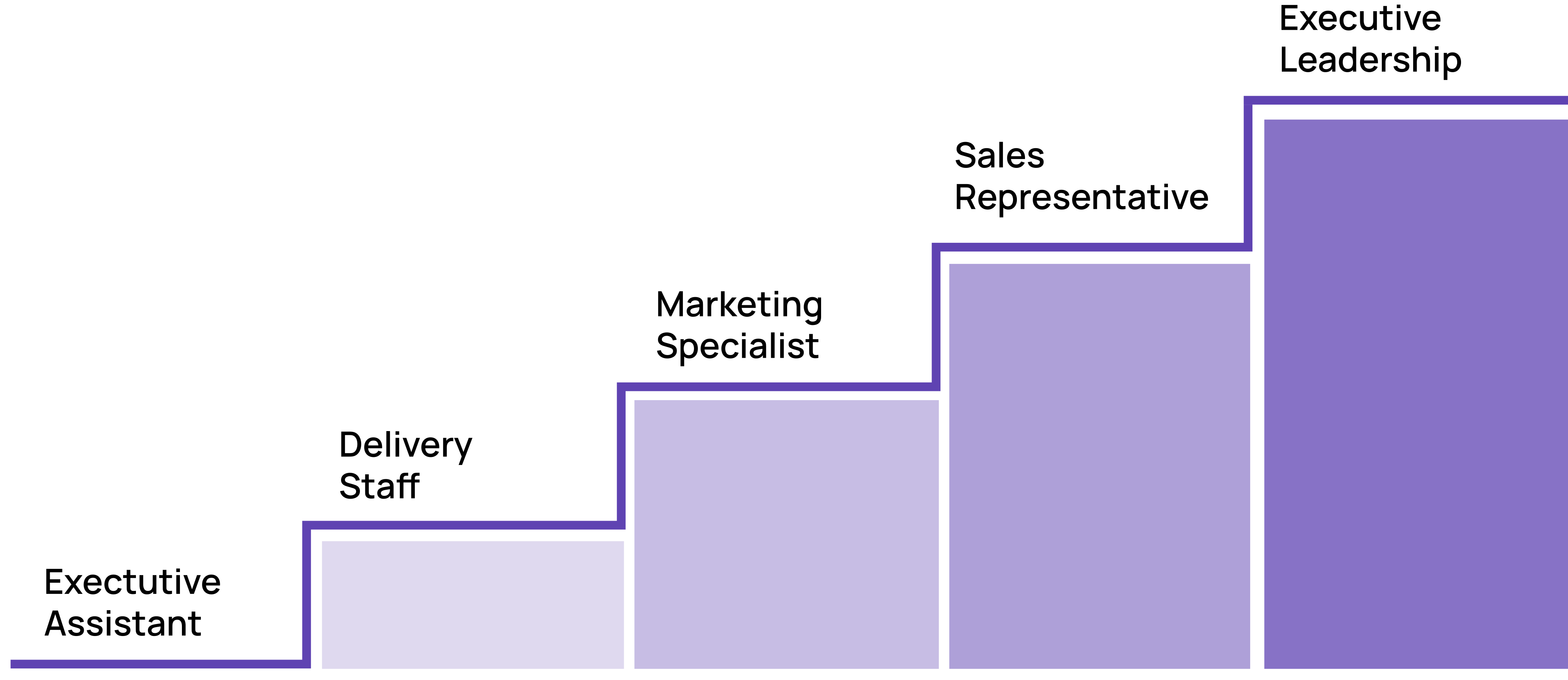
- Golden Concept 3 – Climb the Replacement Ladder
- Golden Concept 4 – Clone Yourself With an EA
- Golden Concept 5 – Building the Playbook
- Golden Concept 6 – Follow the 10/80/10 Rule
- Golden Concept 7 – Create Your 10x Vision Map
- Conclusion
- Frequently Asked Questions
If you’re reading this article, you’ve either already read Dan Martell‘s book, Buy Back Your Time, and need a refresher on how to apply its lessons – or you’ve bought the book but can’t find the time to read it. Either way, this message is for you.
What is that message? It’s not about grinding harder or squeezing more hours from your day. It’s about shifting your mindset and adopting systems to focus on the high-value work that energizes you and drives results.
Dan’s book teaches you how to trade money for time, buy back your calendar, and achieve success without burnout. The core idea? The Buyback Principle.
“Buyback Principle: Don’t hire to grow your business. Hire to buy back your time.” ~ Dan Martell, Buy Back Your Time
If the thought of hiring more people to buy back your time causes you more pain, congratulations – you’re ready to elevate your business to the next level. We use Dan’s book to address the three most common excuses that hold entrepreneurs back from hiring the help they need:
- “I can’t afford it.” (Answer: Understand your Buyback Rate.)
- “It’s too much work to delegate.” (Answer: Follow the Replacement Ladder.)
- “I can’t trust anyone else to do it like I do.” (Answer: Use the 10/80/10 Rule.)
In this article we will share 7 Golden Concepts from Dan’s book to help you build a scalable business and a life you love.
Golden Concept 1 – Figure Out Your Buyback Rate
Every entrepreneur should know their “buyback rate.” This is the hourly rate at which it makes sense to outsource tasks you’re currently doing.
Here’s how it works: Take your total income (salary, profits, and discretionary expenses) and divide it by 2,000 – the average number of hours a person works in a year. This gives you your hourly rate. To ensure a good return on investment (ROI), divide that hourly rate by four. The result is your buyback rate – the amount you should pay someone else to handle tasks that free up your time.

For example, let’s say your income last year was $140,000. Divide $140,000 by 2,000 to get $70/hour. Divide that by four, and you get $17.50/hour. That $17.50/hour is your Buyback Rate – what you should pay someone to complete tasks for you. Hiring at this rate gives you a 4X return on investment.
This means you shouldn’t spend your time doing tasks that could be outsourced for $17.50/hour or less. Instead, focus on keeping high-value tasks on your plate while delegating low-value, energy-draining work to others. The freedom this creates allows you to focus on activities that drive revenue and reduce stress.
Golden Concept 2 – Execute Your Buyback Loop
The buyback loop is a straightforward system comprised of three simple steps:
- Audit: Start with a time and energy audit. Separate the tasks that drain your energy from the ones that fuel it. Focus on identifying low-value tasks – things that you could pay someone else to handle at a fraction of your hourly rate.
- Transfer: Take those low-value tasks and offload them. This might mean hiring someone new, renegotiating responsibilities with your current team, or hiring a virtual executive assistant. The goal is to clear your calendar of anything that doesn’t need your unique skills.
- Fill: Fill the space you’ve created with high-value activities. Focus on tasks that drive revenue, or invest in personal and professional growth.

How Do You Execute This Buyback Loop?
Dan Martell suggests starting small: spend a portion of your income to hire people for minor tasks. This frees up time for high-value work that generates more revenue. As your profits grow, reinvest in hiring for larger tasks, creating a flywheel of profit, freedom, and fulfillment.
Every time you hit the pain line, run the buyback loop again. It’s a repeatable system that lets you scale your business while building a life you don’t want to escape from.
Scenario: James spends 20 hours a week dealing with operational chaos. Action: He audits his time, delegates client complaints to a customer success manager and administrative tasks to an executive assistant, then fills the freed-up hours with systematizing processes and family time. Result: James reduces his stress and reclaims his personal life while solving high-level business problems more effectively.
Golden Concept 3 – Climb the Replacement Ladder
At the top of every business is a bottleneck. The bottleneck isn’t somewhere down the chain – it’s you. Your time, decisions, and inability to delegate effectively create the constraints that keep your business from scaling. To achieve true scalability, leaders must systematically transfer responsibilities through the Replacement Ladder.
Level One: Administration or Executive Assistant
The foundation of scaling is hiring an executive assistant. Million-dollar businesses aren’t built on $60 tasks. By delegating time-consuming activities like managing your inbox, scheduling, booking travel, running errands, or conducting research, you’ll free up your time to focus on growing your business.
Wondering where to find the perfect Remote Executive Assistant? DonnaPro is a virtual assistant service specialized exclusively for CEOs and Founders, offering pre-vetted and trained remote assistants to leaders across the UK and Europe. Save 60 hours per month without the headache of searching and onboarding one yourself.
Level Two: Delivery
The next step is to hire someone to handle post-sale tasks. This includes fulfillment, customer onboarding, taking payments, or managing customer support. Key Hire: Customer success/support staff.
Level Three: Marketing
Once delivery is covered, bring in someone to own your marketing efforts – running campaigns, generating leads, and monitoring traffic. At this point, it’s no longer the CEO’s job to build and oversee lead generation. Key Hire: Marketing manager or specialist.
Level Four: Sales
After marketing, hire a salesperson. But timing is everything – don’t do this before your marketing engine is in place. Without a steady flow of leads, your salesperson won’t have enough opportunities to succeed. Key Hire: Sales representative or manager.
Level Five: Executive Leadership Team
The final level is building an executive leadership team – leaders who take over entire functions of your business. The key is accountability. These hires should own the strategy, outcomes, and targets of their departments. Key Hire: COO, VP, and/or department heads.
Golden Concept 4 – Clone Yourself With an Executive Assistant

Many entrepreneurs balk at the thought of handing off tasks they’ve been doing since the beginning. If delegation feels like giving up control, this is the perfect time to reassess your beliefs and shift your mindset on the value of your time.
“If your business depends on you, you don’t own a business – you have a job. And it’s the worst job in the world because you’re working for a lunatic!” ~ Dan Martell, Buy Back Your Time
Your first hire needs to be an administrative (virtual) assistant. Administrative assistants excel at managing schedules, handling emails, and solving problems objectively. Your EA can likely do these tasks better than you, because they are free from the emotional and psychological hangups that cause procrastination.
How EAs Buy You More Time
- Taking the heat off tough conversations. Whether it’s scheduling a tricky meeting with a demanding client or chasing down overdue invoices, assistants handle these tasks with objectivity and professionalism.
- Project management. Whether it’s tracking deadlines, assigning tasks, or following up with team members, EAs keep your projects moving forward without constant oversight.
- Making your calendar and inbox work for you. From blocking time for deep work to managing email chaos, they keep your day organized and productive.
- Data analysis and reporting. EAs can compile, organize, and analyze data, delivering concise reports that help you make informed decisions.
- Client relationship management. Your EA handles routine client interactions, maintains regular follow-ups, and ensures no relationship slips through the cracks.
Golden Concept 5 – Building the Playbook
A Playbook is a documented process for every key area of your business, ensuring consistent execution and scalability. If you find yourself constantly giving input on repetitive tasks, it’s time to create one. Playbooks are frameworks for predictable results – ensuring a process can be replicated to deliver high-quality outcomes without your constant involvement.
How to Create a Playbook
Start by focusing on the area of your business that causes you the most pain, and use the 4 C’s Framework:
- Camcorder Method. Record yourself performing the task using tools like Loom. Do this at least three times to capture any variations in the process. Talk through each step as you work to provide clarity.
- Course. Use transcription tools to turn the best recording into text. Refine it with AI into a clear, organized procedure document. Include both high-level steps and detailed instructions anyone on your team can follow.
- Cadence. Specify how often the task needs to be performed – daily, weekly, or as needed.
- Checklist. Create a simple checklist to ensure every step is completed consistently. This acts as a quality-control tool, empowering your team to execute autonomously.
Golden Concept 6 – Follow the 10/80/10 Rule
This framework is for anyone who feels their work is too unique or specialized to delegate effectively. Here’s how it works:
- The First 10%: Ideation. This is where your expertise and vision are most valuable. Share your ideas, explain the desired outcomes, and lay out the key elements of the project. You set the creative direction and goals.
- The 80%: Execution. Step back and let someone else take over. Your team moves the project forward – researching, prototyping, outlining, or drafting – translating your ideas into something tangible.
- The Final 10%: Integration. Re-enter the process to refine and polish. Add your unique fingerprint to ensure the final product aligns with your vision.
A great example is Steve Jobs. He collaborated with Jony Ive on groundbreaking ideas, then trusted the Apple team to handle prototyping, sourcing materials, and execution. Jobs would step back in for the final 10%, refining presentations to perfection before unveiling them to the world.
Golden Concept 7 – Create Your 10x Vision Map

This framework focuses on four critical areas of your life and challenges you to dream big. Why 10x instead of 2x? Because incremental growth forces you to stretch the same resources, while exponential growth pushes you to rethink everything and create breakthroughs.
1. Your Team. To achieve any big dream, it starts with the people you surround yourself with. Your team is the foundation for scaling your vision. Identify the people who can help take things off your plate, amplify your efforts, and move your vision forward.
2. Your Primary Business. Ask yourself: what is your current focus? Now imagine multiplying that by 10. Not just in vague terms like “better” or “bigger” – but specifics: team size, revenue, profits, sales, operations, and impact.
3. Your Empire. Every great entrepreneur has either scaled their primary business to new heights or created complementary ventures. Dream without limits – focus on the “what” instead of the “how,” letting your vision be driven by excitement and passion.
4. Your Lifestyle. The buyback principle isn’t just for your business; it’s about creating the life you truly want. Be clear about your vision for your personal life. Without this clarity, you risk climbing the ladder of success only to find it’s leaning against the wrong wall.
Conclusion – Apply These Key Concepts to Reclaim Your Freedom
You don’t have to trade your family’s precious memories for your business ambitions. You don’t have to wait until retirement to escape the grind. You can have both: the thriving business you’ve envisioned and the time to be present with the people who matter most.
It starts with the Replacement Ladder – hiring your first administrative assistant to take low-value tasks off your plate. Through the Buyback Loop, you continuously identify, transfer, and replace those tasks, freeing your calendar with each cycle. With Playbooks, you ensure the systems you build are repeatable and scalable. The 10/80/10 Rule allows you to stay involved in the creative work you love while delegating the rest. And with the 10x Vision Map, you redefine success – not just for your business, but for your life.
Claim Your Free Strategy Session
Frequently Asked Questions
Your Buyback Rate is the hourly wage you should pay to outsource tasks. Calculate it by dividing your total annual income by 2,000 hours to get your hourly rate, then divide that hourly rate by four for a 4x ROI.What is a Buyback Rate and how do I calculate it?
The Buyback Loop is a three-step system – Audit, Transfer, Fill. First audit low-value tasks, then transfer them to others, and finally fill the freed time with high-value work that drives growth.How does the Buyback Loop help me reclaim time?
The Replacement Ladder is a five-level hiring sequence – from an executive assistant through to an executive leadership team – that ensures you delegate tasks in the optimal order to scale without bottlenecks.What is the Replacement Ladder and why is it important?
The 10/80/10 Rule divides a project into three phases: you contribute the first 10% (ideation), delegate the middle 80% (execution), and return for the final 10% (integration and polish).How do I apply the 10/80/10 Rule when delegating?
A 10x Vision Map challenges you to envision exponential growth across four areas – team, primary business, empire, and lifestyle – so you set bold targets and align your actions to achieve them.What is a 10x Vision Map and how do I create one?
A virtual executive assistant can handle scheduling, email management, research, and routine operations, freeing you to focus on high-impact activities.How can a virtual executive assistant help my business?
A virtual executive assistant can take over inbox management, calendar coordination, travel arrangements, data entry, client follow-ups and much more. See all offerings in our virtual assistant services page.What tasks can a virtual executive assistant offload from me?